Happy Black History Month! Within Our Gates is the earliest known film by an African-American director. Usually considered a response to Birth of a Nation, it was released during a period of violent racial tension in the United States that followed the Great Migration of southern blacks to the north.
The film follows a young woman (Sylvia) as she runs into various perils while she is trying to raise money for a black school in the south. The movie is pretty straightforward until it nears the end, when Sylvia's father is framed for a crime. The pace really picks up as her family is being chased down by white townspeople. After Sylvia's family is captured, a white mob lynches her parents; Sylvia and her brother narrowly escape. The lynching scene is the most famous in the film.

In contrast to D.W. Griffith's one-sided vision of post-Civil War race relations in the United States, Oscar Micheaux offers a more complex look at some of the issues blacks faced. Not all the white characters are unsympathetic in this film, and not all the black characters are sympathetic. Sylvia eventually gets $50,000 for her school from a white philanthropist, while two black characters are shown "selling out" -- one denounces the idea of suffrage just to please the whites around him, and another turns Sylvia's family in to an angry mob in hopes of personal gain. At the end of a film, a rich white man chases Sylvia down, but lets her go after realizing she is his biological daughter.

The censors objected to this film because they feared it would incite more race riots like the one in Chicago in 1919. The objections caused some cities to show the film only with major scenes cut out, leading to multiple versions of the film. All prints later disappeared and the film was lost for decades until a single copy was found in Spain under the title "La Negra" in the 1970s.
This film isn't exactly one you would settle in and watch with a bucket of popcorn, but it is a very important piece of social history that would make a good teaching tool for classes/modules about the early 20th century in America. it's classified as a "race film," but I don't really agree with that label, since the cast isn't all black and the movie doesn't seem targeted just toward a black audience. It's meant to educate all people about racism, women's rights, and the importance of education.
The film follows a young woman (Sylvia) as she runs into various perils while she is trying to raise money for a black school in the south. The movie is pretty straightforward until it nears the end, when Sylvia's father is framed for a crime. The pace really picks up as her family is being chased down by white townspeople. After Sylvia's family is captured, a white mob lynches her parents; Sylvia and her brother narrowly escape. The lynching scene is the most famous in the film.

In contrast to D.W. Griffith's one-sided vision of post-Civil War race relations in the United States, Oscar Micheaux offers a more complex look at some of the issues blacks faced. Not all the white characters are unsympathetic in this film, and not all the black characters are sympathetic. Sylvia eventually gets $50,000 for her school from a white philanthropist, while two black characters are shown "selling out" -- one denounces the idea of suffrage just to please the whites around him, and another turns Sylvia's family in to an angry mob in hopes of personal gain. At the end of a film, a rich white man chases Sylvia down, but lets her go after realizing she is his biological daughter.
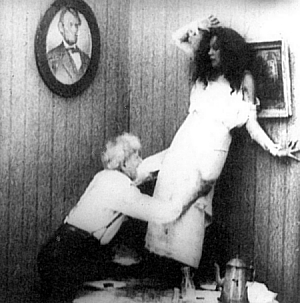
The censors objected to this film because they feared it would incite more race riots like the one in Chicago in 1919. The objections caused some cities to show the film only with major scenes cut out, leading to multiple versions of the film. All prints later disappeared and the film was lost for decades until a single copy was found in Spain under the title "La Negra" in the 1970s.
This film isn't exactly one you would settle in and watch with a bucket of popcorn, but it is a very important piece of social history that would make a good teaching tool for classes/modules about the early 20th century in America. it's classified as a "race film," but I don't really agree with that label, since the cast isn't all black and the movie doesn't seem targeted just toward a black audience. It's meant to educate all people about racism, women's rights, and the importance of education.

