Showing posts with label silent movies. Show all posts

Thursday, March 7, 2013

14. Nanook of the North (1922)


The first documentary on the 1001 list, Nanook of the North is a groundbreaking film that depicts the rigors of subsistence living in northern Quebec. It follows the eponymous Nanook as he hunts, builds igloos, and engages in other survival-related activities to keep his family from starving or freezing to death. Also depicted in the film are Nanook's wife, Nyla, and their children.

Nanook of the North was the first documentary in history to be commercially successful and is still praised as one of the greatest achievements in the genre. In fact, this film almost singlehandedly established documentary as a new genre, though a name didn't exist for it yet. Very early one-reel films had depicted people going about their daily lives, but this was the first feature-length film to depict "real life" and focus on one subject. The only problem is, almost everything in Nanook of the North is staged. The family in the movie wasn't really a family, they were members of an Inuit community that director Robert Flaherty cast in the roles. The main character's name wasn't even Nanook. And he didn't die of starvation shortly after filming as the film claims.

Robert Flaherty was a young prospector and explorer sent to the Arctic by a railroad company in the early 20th century. Somewhere around 1913-14 he started filming the Inuit he encountered on his travels. For the next couple of years, he filmed them going about their daily lives until he had enough footage for a feature-length film. Then tragedy struck: he dropped a cigarette butt on the negative of his film (it's flammable stuff) and 30,000 feet of it burned up in an instant. He wasn't satisfied with the scenes left in tact, so he decided to raise money and return to the Arctic to shoot new footage.

Upon his return north in 1920, Flaherty set about making his film with a more focused plan than what he had before. He cast a few Inuit as the main characters of his film and hired other members of the Inuit community to be his crew. By this time, the Inuit in the area had started wearing Western-style clothing and hunting with guns, but Flaherty wanted to depict their traditional way of life, so in the film they only wear animal skins and hunt with weapons carved from animal bones. The hunting scenes in the movie are real--the actor playing Nanook actually kills live animals on camera (I don't recommend watching this if you're a vegetarian).

One of the most interesting scenes shows the family building an igloo from start to finish. In reality, more than one igloo was built for this sequence: the "family" built one to be shot from the outside, and another 3-sided igloo was built with the 4th side open so Flaherty could shoot some inside shots.

Even if the activities were staged, it's still interesting to see the traditional Inuit way of life and the movie is a good example of salvage ethnography. Even if the Inuit had been exposed to Western influences by 1922, they weren't so far removed from their traditional habits that they didn't know how to hunt with just a knife or a spear. I suspect there are plenty of scenes in modern documentaries that are staged for effect.

Unlike Flaherty, the Inuit involved in the film did receive any concrete benefits from the film. The woman who played Nyla reportedly bore a son fathered by Flaherty, but Flaherty never acknowledged him, despite the difficult circumstances of the boy's life--he was part of a group of Inuit relocated by the Canadian government to the High Arctic in the 1950s. The actor who played Nanook died of tuberculosis a few short years after the film was released.

The success of this film brought Flaherty worldwide acclaim and allowed him to continue directing films. His second film would inspire a fellow film-maker to coin the term "documentary." There are two other films by Flaherty on the 1001 list, Tabu and The Louisiana Story, both of which are hybrid documentary/narrative films with ethnographic themes.

Tuesday, March 5, 2013

13. Nosferatu (1922)

Nosferatu is the second great Expressionist film on the 1001 list (here's the first.) Its director, F.W. Murnau was one of the poster boys for German Expressionist cinema and one of the most influential directors of the Silent Era in general. He spent the first few years of his career making a name for himself in Germany, and then immigrated to the United States in 1926 to work in Hollywood. He would die of injuries sustained in a car crash at the tender age of 42, but he achieved great heights in his relatively short career.

Nosferatu is Murnau's best known film, but the origins of the film began with producer Albin Grau. When he was fighting in World War I in 1916, a Serbian farmer told Grau that the farmer's father was one of the undead, a vampire. A lifelong student of the occult, Grau was intrigued.

Fast forward to 1921. Grau and partner Enrico Dieckmann established Prana Film for the purpose of producing films with supernatural or occult themes. Remembering the Serbian farmer's tale from five years earlier, Grau decided their first film would be about vampires.

Grau and Dieckmann hired a writer experienced in dark romanticism to write a screenplay based on Bram Stoker's Dracula. The playwright renamed the characters and changed other aspects of the story enough that the filmmakers hoped they could get away with not having film rights to the book.

The resulting screenplay was detailed and rhythmic, filled with copious notes on lighting and camera angles. Murnau would rewrite some portions of the screenplay, but he kept the rhythmic feel in tact, even using a metronome during filming to keep the actors' movements in time with his script notes.

Murnau hired actor Max Schreck to play the film's version of Dracula, Count Orlok. His involvement in the film would become legendary in its own right (more on that later), but in real life he was an actor who had both stage and film experience before he was offered Nosferatu.

Filming took place in Germany (the town shots) and Slovakia (Count Orlok's castle). The production could only afford one camera, so there was only one original negative of the film (!!!).


Dracula is an epistolary novel, where the plot is told through a series of documents--diary entries, letters, newspaper articles, etc. The film keeps this format in tact, using the documents as title cards.

The beginning of the movie starts out just as Dracula does: young lawyer travels to visit Transylvanian Count on business.

Near the middle, it starts to deviate a little: the Count, now revealed to be a vampire, makes his way to Germany (England in the book.)

The ending of the movie differs more widely from the book than the rest of the story (I won't spoil it here).

The character of Van Helsing is almost completely left out of the movie, which made me really sad because I read the book a couple years ago and Van Helsing was my favorite character by far. It would have been nice if the studio had made a part 2 focusing on the Van Helsing parts of the book, but sadly, they never got the chance.

The film was released in 1922 with an ad campaign and a lavish release party and the producers had high hopes for its success. But the fate of the film's legacy was threatened when Bram Stoker's widow sued for copyright infringement and won. At Mrs. Stoker's request, the court ordered that all the existing prints and negatives be destroyed.

Luckily, at least one print survived outside Germany. Copies were made and the film surfaced again in the late 20s. This is why the release date is sometimes listed as 1929: that's when it was first shown in the United States.

The costs of the lawsuit caused Prana Film to declare bankrupty. Albin Grau's vision of a studio producing only supernatural-themed films would be short lived. But in its brief existence, Prana Film did give the world one groundbreaking classic.

Another part of the film that miraculously survives to this day is the shooting locations. Almost all of the buildings used in the film survived World War II and are still standing in Wismar and Lübeck, Germany, and northern Slovakia. One could feasibly make a pilgrimage there. Maybe Nosferatu tours already exist?

___________________________________________________________________________


One interesting thing about reading/watching stuff about vampires is you get to see how vampire lore has evolved over time. Most modern depictions of vampires show the influence of Stoker's characterization of Count Dracula as a cool, suave aristocrat. Nosferatu's vampire is a Count, but has none of the gentlemanly manners of the Count in Stoker's book. He's 100% creepy and is more of a rat/lizard creature than a human.


In addition to the indelible images of Count Orlok that this film contributed to the world, Nosferatu is also the point of origin for the idea that sunlight is fatal to vampires. That was not in earlier vampire fiction, but it entered the canon of vampire lore starting with this film. It demonstrates how much movies play a role in shaping public consciousness. An earlier example from the 1001 list is Birth of a Nation, which established burning crosses and white costumes as KKK iconography.


Nosferatu has inspired at least two feature-length films. The first was Werner Herzog's 1979 film Nosferatu: Phantom of the Night, starring Klaus Kinski (awesome in whatever role he plays). By 1979, Dracula had entered the public domain, so Herzog restored the original character names from the book. He wanted to make a stylistic homage to Nosferatu because he considered it the greatest German film ever produced, and he even copied some shots verbatim. This movie is on the 1001 list, so I'll be watching it at some point. 


The second feature film based on or inspired by Nosferatu was Shadow of a Vampire in 2000. Its plot is based on the legend that Max Schreck really was a vampire and director F.W. Murnau (played by John Malkovich) convinced him to appear in Nosferatu, but Murnau doesn't tell the rest of the cast and crew that they're dealing with a real vampire. The myth about Schreck began when someone claimed there was no evidence he had been in any other movies (this was later proved to be false). If it were true, that would have been the greatest casting move in history. Shadow of a Vampire is not on the 1001 list, but I might watch it anyway, because the premise sounds pretty entertaining. The role of Max-Schreck as real vampire" was reportedly written specifically for Willem Dafoe (more inspired casting).

__________________________________________________________________

So that's the general story of Nosferatu. A little more about the nuts and bolts of the movie:

It's one thing to look at pictures of Count Orlok and think he is creepy, but it's a totally other feeling to actually see him in motion.


The first time he appears on screen is some of the most awesomely creepy footage I've ever seen. He only blinks once in the entire movie, and he appears to slither across the screen as he moves with quick, tiny steps and hunched over shoulders. Like I said before, he seems like more of a rat/lizard creature than a person, and his character development doesn't go much further than that. 

This film has all the striking visuals and effective use of shadow that The Cabinet of Dr. Caligari does, but the main difference is that whereas Caligari was obviously shot on a stage with matte paintings as backgrounds, Nosferatu was shot on location. That does give the film an air of realism, and the Count's movements are all so perfect that I can see why some people did not believe Max Schreck was just playing a role. This movie probably has the widest range of visual effects I've seen yet in a film on the 1001 list.

I was sad they greatly diminished Van Helsing's character, but the changes to the plot make for a movie that's just right in pacing and length. It's available to watch on Netflix. I suggest you check it out.

Tuesday, February 26, 2013

12. Foolish Wives (1922)

Disclaimer: I've noticed that the films are in a slightly different order depending on which edition of the book you look at. So from now on I'm going to just try and go in roughly chronological order, but I probably won't get it 100% right.

-----------------------------------------------------------------

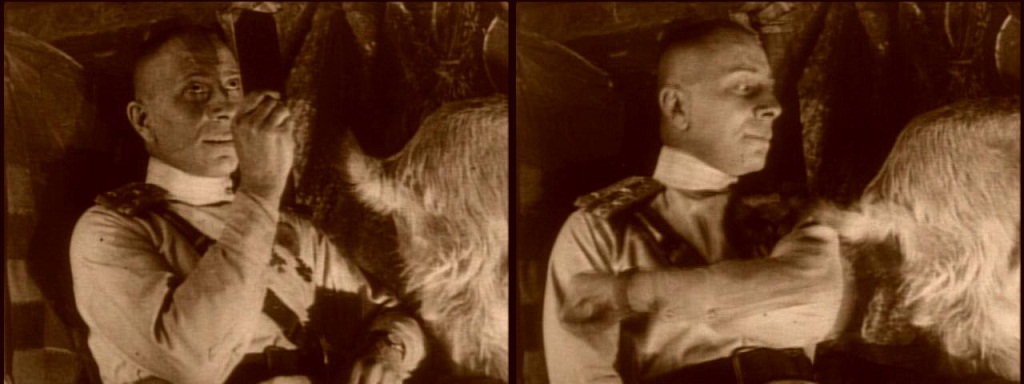
Remember this guy from Sunset Boulevard?


How could you not? Gloria Swanson makes the movie, but he provides a memorable assist. The character's name is Max von Mayerling and he is described as "one of the three greatest silent directors" who is now working for his ex-wife Norma Desmond as her butler. It's some of the most inspired casting in film history, because the actor (Erich von Stroheim) actually was a famous silent director who had been mostly forgotten in America by the time Sunset Boulevard came out in 1950.

Von Stroheim's story proves as well as anyone's how it's possible to totally reinvent yourself in Hollywood, but you have to work hard to stay relevant and be willing to make compromises. Your ego can only carry you so far.

These days he is viewed as an auteur, which I think is just a fancy word for pain in the ass/batshit crazy. For example, he thought many of his movies should run 6-10 hours because he was obsessed with exploring all the details of a story. All the tales behind his films are about him being difficult and inflexible to work with, and he brought down his career by refusing to compromise on his artistic ideals to make commercially successful films.


Foolish Wives is considered the first "big" movie that he directed. It was also the first movie that was advertised as costing over $1 million dollars. It was originally budgeted for $250,000, but Universal Studio estimated it ended up costing $1,225,000 (von Stroheim argued differently, that it cost "only" $750,000).

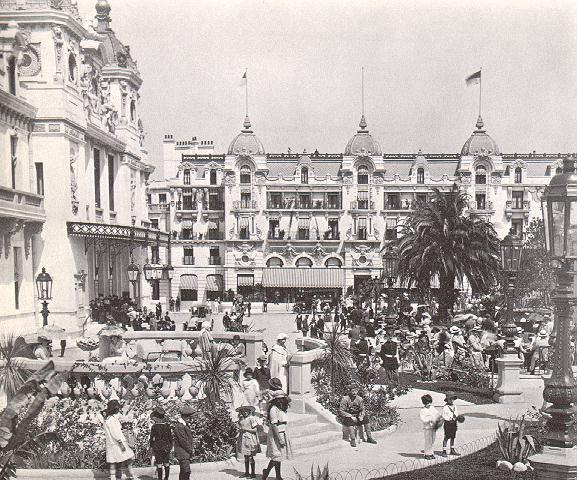
Foolish Wives takes place in Monte Carlo and tells the story of a con man (played by von Stroheim) who poses as a Russian count. He's known for being a ladies' man and he zeroes in an the young wife of the American ambassador as his next target. Working with him are two female accomplices who pose as his cousins.

In a strange twist of irony, the theme of a man posing as an aristocrat mirrors von Stroheim's own life:  he was born Erich Stroheim, son of a lower-middle class Viennese hat-maker, but when he arrived in America he registered himself as Count Erich Oswald Hans Carl Maria von Stroheim und Nordenwall, Austrian noble. He didn't completely get away with the ruse, however; other German speakers in Hollywood outed him as having a lower-class Austrian accent. Others say he didn't speak German at all, and later in life von Stroheim claimed he had forgotten his native tongue completely.

So, you have an enigmatic guy who rewrites his own backstory in America and does the same thing for characters in his films. Despite never having served in the military, von Stroheim often wrote himself into movies as high-ranking military officers.


In addition to casting himself as a smooth playboy-type, this film has another really big hint at von Stroheim's ego in the scene where he first meets his prey as she is reading a book on a hotel veranda. The book's title? "Foolish Wives, by Erich von Stroheim." 

I will say that the art direction in this movie is fantastic. The recreation of Monte Carlo is exquisite.


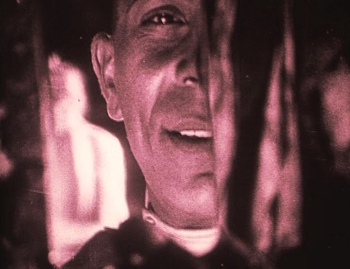
There was one scene that stuck out at me as really creative in which the Count uses a bit of mirror to spy on the diplomat's wife as she is undressing. You see a little sliver of what he is seeing, but the focus is on his face and how much he's enjoying being a voyeur.


One of the trademarks that gave von Stroheim the "auteur" label is the cynicism that pervades his films. This film employs the motif of innocence lost that I've mentioned so much recently, but the difference here is that the bad guy gets a lot more screen time and isn't really presented as, well, a bad guy. The blame is placed pretty squarely on the victim--the film's title is Foolish Wives, not Evil Playboys. It reminds me of Goodfellas: the "bad" guys do bad things, sure, but the lifestyle is just so glamorous and fun, how could anyone resist! It's the other person's fault for being such a schmuck! If the message of D.W. Griffith movies is "watch out for bad guys," the message of this movie is, "bad guys are sexy."

I find von Stroheim to be pretty fascinating, so I'm looking forward to seeing his other movie on the list, Greed.


Tuesday, February 19, 2013

11. Orphans of the Storm (1921)

Orphans of the Storm is the last D.W. Griffith movie on the list, and my feelings about it are pretty similar to what I felt about the rest of them (with the exception of Broken Blossoms): the technical aspects of the film are praiseworthy (the set pieces are particularly impressive), but the characters and plot are formulaic and left me feeling pretty bored. I figured out how this movie was going to end with over an hour of running time left.


Lillian Gish and her sister Dorothy play the requisite innocent heroines in a French Revolution setting, bad guys threaten to tarnish their innocence, etc., a battle between good and evil ensues....you get the idea.

Factoids about this film:

It is based on a play called "The Orphans" that had already been filmed at least twice before 1920; one version starred Theda Bara and was released in 1915. (I've seen some other examples of multiple silent films being based on the same source material--I guess the precedent for the current remake frenzy sweeping Hollywood was set a long time ago!) Theda Bara was one of the film industry's first sex symbols/femme fatales. She made over 40 films in her career but, unfortunately, most of them were lost in a fire in 1937 and very little footage of her survives to this day.

This movie is the last Griffith film to star Lillian Gish, and it's also considered his last big commercial success.

I am so glad to have all the D. W. Griffith films on the list behind me now.


Thursday, February 14, 2013

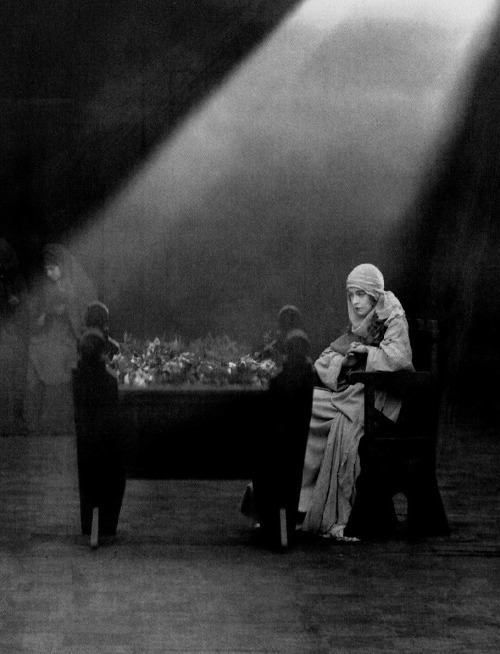
10. The Phantom Carriage (1921)

The frame story of The Phantom Carriage is that whoever dies last on New Years' Eve is doomed to serve as Death's servant for the following year and collect people's souls when they die. The doomed servant of Death must ride around in a ghostly carriage to accomplish the task.

The film opens on New Years' Eve as a young Salvation Army sister lies ill on her deathbed. Her final wish is to speak to a man named David Holm before she dies. The next scene reveals that David Holm is a local drunk, but it's not immediately clear what the connection is between him and the girl. The rest of the movie explains the connection between them, and also what happens next for David Holm.


I absolutely LOVED this movie. It is suspenseful and chilling from the start and never really lets up.
This film is known for its use of extensive flashbacks and special effects: the carriage and the dead characters appear transparent. The effects add a lot to the film and make it extremely eerie.


The effects were created with multiple double exposures. And cameras had to be hand-cranked at that time, so the cameras had to be cranked at exactly the same speed for the exposures to match up. Post-production of this film took a while because of these technical challenges, but it all turned out beautifully.

Telling the story with flashbacks is also very effective. And in an early stroke of marketing genius, the movie was first released on New Years' Day in 1921. It had a big impact on a 15-year-old Ingmar Bergman, who would later become Sweden's most celebrated film director.

This is probably my favorite from the list so far. Highly recommended.
The whole thing is available on YouTube, if you want to watch it.


Tuesday, February 12, 2013

9. Within Our Gates (1920)

Happy Black History Month! Within Our Gates is the earliest known film by an African-American director. Usually considered a response to Birth of a Nation, it was released during a period of violent racial tension in the United States that followed the Great Migration of southern blacks to the north.

The film follows a young woman (Sylvia) as she runs into various perils while she is trying to raise money for a black school in the south. The movie is pretty straightforward until it nears the end, when Sylvia's father is framed for a crime. The pace really picks up as her family is being chased down by white townspeople. After Sylvia's family is captured, a white mob lynches her parents; Sylvia and her brother narrowly escape. The lynching scene is the most famous in the film.


In contrast to D.W. Griffith's one-sided vision of post-Civil War race relations in the United States, Oscar Micheaux offers a more complex look at some of the issues blacks faced. Not all the white characters are unsympathetic in this film, and not all the black characters are sympathetic. Sylvia eventually gets $50,000 for her school from a white philanthropist, while two black characters are shown "selling out" -- one denounces the idea of suffrage just to please the whites around him, and another turns Sylvia's family in to an angry mob in hopes of personal gain. At the end of a film, a rich white man chases Sylvia down, but lets her go after realizing she is his biological daughter.


The censors objected to this film because they feared it would incite more race riots like the one in Chicago in 1919. The objections caused some cities to show the film only with major scenes cut out, leading to multiple versions of the film. All prints later disappeared and the film was lost for decades until a single copy was found in Spain under the title "La Negra" in the 1970s.

This film isn't exactly one you would settle in and watch with a bucket of popcorn, but it is a very important piece of social history that would make a good teaching tool for classes/modules about the early 20th century in America. it's classified as a "race film," but I don't really agree with that label, since the cast isn't all black and the movie doesn't seem targeted just toward a black audience. It's meant to educate all people about racism, women's rights, and the importance of education.


Saturday, February 9, 2013

8. Way Down East (1920)

Do not watch this movie on Netflix! I settled in for what I thought was an 83-minute movie and as it neared the end I thought to myself, "hmm....they have a lot of loose ends to tie up in a very short amount of time." Turns out Netflix only has part 1. The full movie is actually 145 minutes long. Luckily the whole thing is posted on YouTube, so I finished it there.


This film is based on a play that premiered in the late 1800s. It was popular through the first decade of the 20th century, but by the time Griffith released his film version, the Victorian plot seemed tired and outdated. It is old-fashioned and trifling even for 1920.

Griffith's reliable heroine Lillian Gish stars again as an innocent young woman who is wronged at the hands of society's less savory characters. Gish plays a poor country girl (Anna) who goes to visit her rich relatives in the big city and gets swept off her feet by a big city playboy who lures her into a sham marriage. After he abandons her, she goes through the traumatic experience of giving birth to an out-of-wedlock baby and being kicked out of a boarding house because of it. After the baby dies, she wanders until finding work on a prosperous farm. Things seem to be looking up until her ex-quasi-husband appears and starts wooing another girl, and the town gossips expose Anna's past and get her kicked off the farm. Reeling from the humiliation, she wanders out into a violent winter storm and eventually collapses on an ice floe headed for a waterfall. Luckily the farmer's son who has fallen in love with her saves her just in time and the film ends with a triple wedding (did those ever really happen in real life, or just in movies?)

The scenes on the ice floes are by far the most interesting part of the movie. Like I said, the rest of it is kind of corny and melodramatic, but it's notable for being the first Griffith movie on the list that has a lot of comedy in it. There are a lot of moments of slapstick comedy involving the minor characters in the film.

This movie was way too long. I don't mind long movies as a general rule, but the length of this one did not feel justified or satisfying. I didn't enjoy this movie nearly as much as the previous Griffith film I watched, and I'm convinced that what made that one good was the fact that Griffith really reined himself in on the length, didn't waste time on a million supporting characters and subplots, and chose a story that didn't have a cliched happy ending.

The ice floe scenes are pretty impressive for 1920, but that's really the only interesting thing about this movie. And filming those scenes had a lasting impact on some of the people involved: Lillian Gish's right hand was in the icy water for so long during the shoot that she had problems with it for the rest of her life (she lived until 1993) and D.W. Griffith also suffered long-term problems from getting frostbite on one side of his face.

This is the 4th of the 5 D.W. Griffith movies on the 1001 list. I wonder if the last one will be a melodrama like this one, or a more satisfying tragedy like Broken Blossoms.

Tuesday, February 5, 2013

Diving into Hitchcock

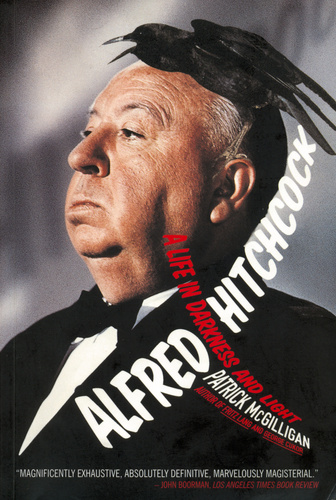
Been working on this book for the past couple weeks.


I picked it up because I read somewhere that it was an extremely well researched and well written biography of Hitchcock, and if there's anything I like more than a good movie, it's a good biography. The "well researched" description is extremely true--at first I was freaked out by the level of detail in it. It seems like the author could tell you what Hitch did every day of his life from the age of 14. Reading it makes me feel like a voyeur peeking into someone else's life, almost like I'm a character in a Hitchcock movie. Whoa.

Originally I was worried that I was getting ahead of myself because I'm currently at 1920 in my project, and I had always connected Hitchcock with a later era in my mind. But my concern over continuity was for naught--Hitchcock's career spanned both the silent and sound eras and he directed films in 6 different decades. So, it's not a bad idea to read a Hitchcock biography while you're trying to learn about general film history. Hitch had quite a few movies under his belt before Britain switched to sound in 1929 (the first British sound production was a Hitchcock picture), so a lot of the things I'm noticing in my project have parallels in his life story. Plus, as an adolescent he was a prolific movie and theater fan, so chances are I am watching movies he saw as a young man when they were in theaters.

Later in life, Hitch would state that his greatest influence was "the Germans": The Cabinet of Dr. Caligari, F.W. Murnau, Fritz Lang, and Ernst Lubitsch. Hitchcock even directed some films in Germany during the 1920s. This explains a lot of his stylistic choices and why many memorable scenes from his movies are set to silence or near silence. He idolized the masters of scenery and atmosphere.

The only Hitchcock movies I saw as a kid are from later in his career, after he became the most famous and picked apart director in the world. There's a lot I haven't seen, and I look forward to diving into it with all this new knowledge I'm gaining.

My favorite quote from the book so far-

After being told by a writer that a certain plot wasn't logical:

"I'm not interested in logic, I'm interested in effect. If the audience ever thinks about logic, it's on their way home after the show, and by that time, you see, they've paid for the tickets."

It's all about effect, you see.

If you're interested in other great books about directors, this one about David Lean is fantastic. Highly recommended. 

Saturday, February 2, 2013

7. Broken Blossoms (1919)

This is the third film by D. W. Griffith on the 1001 list, and the first I have enjoyed. There are still some aspects of this movie that are cringe-worthy (its alternate title is "The Yellow Man and the Girl") but overall this film is more nuanced and sensitive than the others. Its themes are no less complex than Griffith's other two previous films on the list, but his staging is less ambitious here and that serves him well in getting his message across.


Cheng Huan (Richard Barthelmess) leaves his native China because he "dreams to spread the gentle message of Buddha to the Anglo-Saxon lands." His idealism fades as he is faced with the brutal reality of London's gritty inner-city. However, his mission is finally realized in his devotion to the "broken blossom" Lucy Burrows (Lillian Gish), the beautiful but unwanted and abused daughter of boxer Battling Burrows (Donald Crisp).

After being beaten and discarded one evening by her raging father, Lucy finds sanctuary in Cheng's home, the beautiful and exotic room above his shop. As Cheng nurses Lucy back to health, the two form a bond as two unwanted outcasts of society. All goes astray for them when Lucy's father gets wind of his daughter's whereabouts and in a drunken rage drags her back to their home to punish her. Fearing for her life, Lucy locks herself inside a closet to escape her contemptuous father.
By the time Cheng arrives to rescue Lucy, whom he so innocently adores, it is too late. Lucy's lifeless body lies on her modest bed as Battling has a drink in the other room. As Cheng gazes at Lucy's youthful face which, in spite of the circumstances, beams with innocence and even the slightest hint of a smile, Battling enters the room to make his escape. The two stand for a long while, exchanging spiteful glances, until Battling lunges for Cheng with a hatchet, and Cheng retaliates by shooting Burrows repeatedly with his handgun. After returning to his home with Lucy's body, Cheng builds a shrine to Buddha and takes his own life with a knife to the stomach.

This film was made during a period of anti-Chinese fear called the Yellow Peril. But in contrast to Griffith's fear-mongering The Birth of a Nation and confused Intolerance, this film preaches a message of tolerance. Griffith adapted the plot from a popular book of the era, but changed the nature of the main character to make him much more sympathetic. I can almost forgive Griffith for calling Cheng Huan "yellow man" and "chinky" because of how sensitively he frames the character's personality.
This movie was successful and highly praised by both audiences and critics even though viewers were disturbed by the depictions of child abuse. The original backer was so furious over the sad ending--all the main characters die--that Griffith bought the film back from him. It ended up being the first film distributed by United Artists, a collective Griffith started with Douglas Fairbanks, Mary Pickford, and Charlie Chaplin so they could release their own films and avoid dealing with the status quo studio system. 
I liked this movie a lot more than I expected and I'm very curious about the next film on the 1001 list, another Griffith classic.

Fun fact - the actor who played the abusive father in this film, Donald Crisp, was also a director during the silent era and learned much of his tradecraft from D.W. Griffith. Crisp would later star in one of my favorite movies of all time, How Green Was My Valley, and win an Oscar for best supporting actor.

Thursday, January 31, 2013

6. The Cabinet of Dr. Caligari (1919)

Out of all the silent movies on the list, this is the one I was most excited about watching. I've heard a lot about it over the years but never actually seen it before.

This movie is acclaimed as one of the best silent horror movies, and it's also an example of Expressionist cinema. Expressionism started in the early 20th century as an avant garde movement and flourished during the Weimar Republic in Germany (1920s). It's an artistic style that emphasizes emotion over realism.

Expressionist film developed partially because of the isolation Germany experienced during World War I. During the war, the German government banned foreign films, so the German film industry's production rate skyrocketed to make up for the lack of outside material. Once the inflation problem started, Germans started going out and spending their money on quick entertainment like movies so they'd get some use out of the money before it became worthless.

Eventually the rest of the world start appreciating the artistry and inventiveness of German films and German filmmakers gradually got access to more resources. But early on, expressionist films had very small budgets, and the makers compensated for that by making loud set pieces full of non-realistic, geometric shapes. Couple that with Caligari's theme of insanity and you have one very surreal film. 

The plot (stolen from Wikipedia):

The main narrative is introduced using a frame story in which most of the plot is presented as a flashback, as told by the protagonist, Francis (one of the earliest examples of a frame story in film).
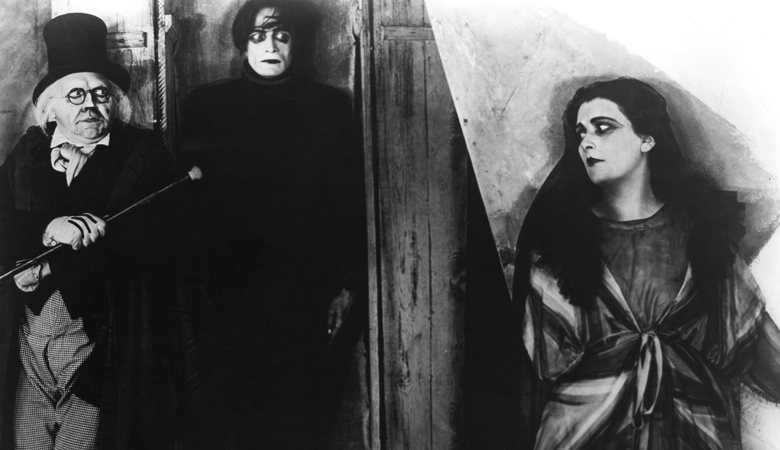
Francis (Friedrich Fehér) and an elderly companion are sharing stories when a distracted-looking woman, Jane (Lil Dagover), passes by. Francis calls her his betrothed and narrates an interesting tale that he and Jane share. Francis begins his story with himself and his friend Alan (Hans Heinrich von Twardowski), who are both good-naturedly competing to be married to the lovely Jane. The two friends visit a carnival in their German mountain village of Holstenwall, where they encounter the captivating Dr. Caligari (Werner Krauss) and a near-silent somnambulist, Cesare (Conrad Veidt), whom the doctor keeps asleep in a coffin-like cabinet, controls hypnotically, and is displaying as an attraction. Caligari hawks that Cesare's continuous sleeping state allows him to know the answer to any question about the future. When Alan asks Cesare how long he will live, Cesare bluntly replies that Alan will die before dawn tomorrow—a prophecy which is fulfilled. Alan's violent death at the hands of some shadowy figure becomes the most recent in a series of mysterious murders in Holstenwall.
Francis, along with Jane, to whom he is now officially engaged, investigates Caligari and Cesare, which eventually results in Caligari's order for Cesare to murder Jane. Cesare nearly does so, revealing to Francis the almost certain connection of Cesare and his master Caligari to the recent homicides; however, Cesare refuses to go through with the killing because of Jane's beauty and he instead carries her out of her house, pursued by the townsfolk. Finally, after a long chase, Cesare releases Jane, falls over from exhaustion, and dies.
In the meantime, Francis goes to the local insane asylum to ask if there has ever been a patient there by the name of Caligari, only to be shocked to discover that Caligari is the asylum's director. With the help of some of Caligari's oblivious colleagues at the asylum, Francis discovers through old records that the man known as "Dr. Caligari" is obsessed with the story of a mythical monk called Caligari, who, in 1703, visited towns in northern Italy and similarly used a somnambulist under his control to kill people. Dr. Caligari, insanely driven to see if such a situation could actually occur, deemed himself "Caligari" and has since successfully carried out his string of proxy murders. Francis and the asylum's other doctors send the authorities to Caligari's office, where Caligari reveals his lunacy only when told that his beloved slave Cesare has died; Caligari is then imprisoned in his own asylum.
The narrative returns to the present moment, with Francis concluding his tale. A twist ending reveals that Francis' flashback, however, is actually his fantasy: he, Jane and Cesare are all in fact inmates of the insane asylum, and the man he says is Caligari is his asylum doctor, who, after this revelation of the source of his patient's delusion, says that now he will be able to cure Francis.
I love the twist ending. 
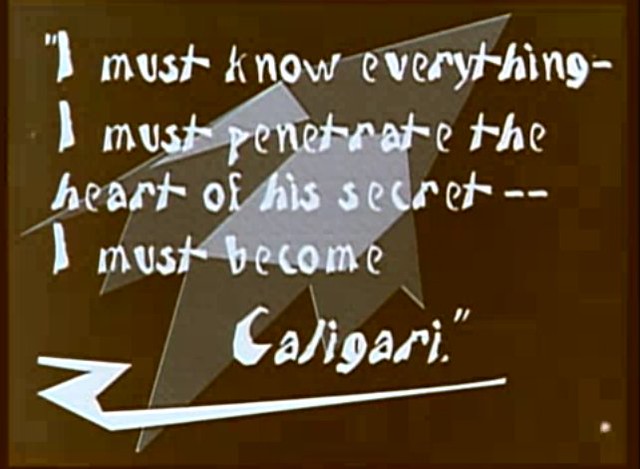
Everything about this movie is distorted and surreal - the acting, the scenery, the music, even the font on the title cards. 

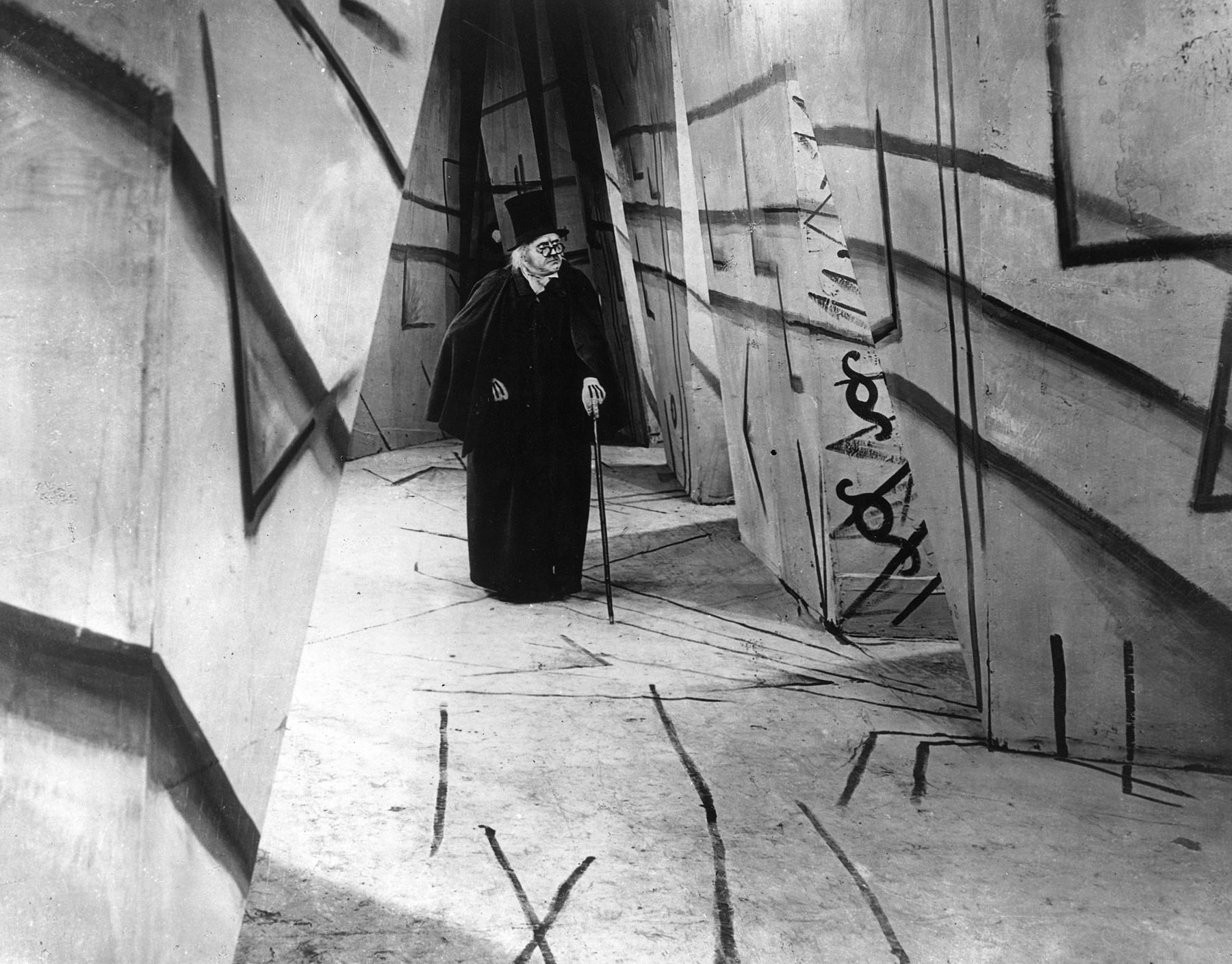
The music is very modern and atonal. At first I was afraid it would annoy me, but after the first couple minutes I hardly even noticed it because it matched the plot so well. The visuals are really what stick with you:


Some of the most interesting art direction you will ever see.

This movie is a trip. Recommended viewing for anyone who is curious about early horror films or is interested in Expressionism. I watched it with a couple friends of mine, and although it probably wasn't what they were expecting, I think they were glad they watched it with me. 

Fun fact: German filmmaking during this period was considered "more artistic" than that in other countries, and the Expressionist style was influential to directors such as Orson Welles and Alfred Hitchcock. More on that later.

Saturday, January 26, 2013

5. Intolerance (1916)

In 1915, D.W. Griffith was developing a film focused on the dangers of social reform called "The Mother and the Law" when critiques of his previous film Birth of a Nation started rolling in. Angered by the accusations of racism in the film, he added additional storylines to his new project that showed the result of intolerance throughout history. This was his attempt at silencing critics.

The outcome was a sprawling, ambitious film that cost a then unheard of $2 million to produce. It received positive critical reviews, but did not do well with the American public (protip: don't make an anti-war film when your country is about to enter a World War ...). The film was originally 3 hours and 30 minutes long, but most modern cuts are 3 hours and 17 minutes. The one I watched was 3 hours 17 minutes.

The plot consists of four stories set in different historical periods that span 2,500 years. To emphasize the thematic connections between the stories, they are intercut throughout the movie instead of being presented linearly.

The film opens with a shot of a woman deemed "Eternal Motherhood" rocking a cradle. She symbolizes the passing of generations, and subsequent shots of her are used to transition between the four stories throughout the film.

The Modern Story (The Mother and the Law)

The largest portion of the film is occupied by the plot of Griffith's original idea pre-Birth of a Nation. A group of early 20th-century female social reformers called "Uplifters" try to gain the patronage of a wealthy spinster whose brother owns a mill so they can further their cause. The wealthy spinster agrees to help finance the Uplifters, but after a while she finds that the mill is not generating enough revenue to satisfy her altruistic pursuits. She complains to her brother, whose response is to order a 10% cut in wages for all his factory workers. After the mill owner orders the wage cut, the workers go on strike but are quickly and violently suppressed by the state militia. (This was based on a real event.) Many victims of the strike move to a nearby city, including the Little Dear One, a young woman who takes care of her father (a former mill worker), and The Boy, another former mill worker. After arriving in the city, the Boy falls into a life of crime working for the Musketeer of the Slums. Another disenfranchised young person called The Friendless One falls in with the Musketeer and becomes his mistress. After struggling to adapt to his sudden life changes, the Dear One's father dies, leaving her alone in the world. The Dear One and the Boy get married and he swears off his former life of crime.

He returns his gun to the Musketeer, but they get in a scuffle and the Musketeer vows revenge because he is now afraid the Boy will turn him in to the police. The Musketeer stages a setup to implicate the Boy in a crime and the Boy is sent to jail. Intercut scenes show the Uplifters celebrating their successes at reforming society. A few months pass and the Dear One has a baby. As her husband is in jail (nevermind that he's falsely incarcerated), the Uplifters are convinced the Dear One is a negligent mother and take her baby away. Once again, the Dear One is alone.

The film's poster showing an evil reformer's hand trying to take the baby from its mother.

The Musketeer goes to the Dear One's apartment and promises to help her get her baby back. The Friendless One (the Musketeer's girlfriend) watches jealously. The Boy is released from jail and reunited with the Dear One.

While the Boy is out one day, the Musketeer goes to the Dear One's apartment to get the address for where the baby is being held. His girlfriend puts a gun in her handbag and follows him without his knowledge. He enters the Dear One's apartment and tries to assault her. As this is happening, an informant tells the Boy that the Musketeer has gone to the apartment. When the Boy arrives, he can already hear a scuffle inside and he kicks down the door. He and the Musketeer get into a fight, during which the Boy and the Dear One are knocked unconscious. The Friendless One (whom nobody knows is watching) leans in through a window and shoots the Musketeer. When the Dear One and the Boy come to, they see the dead Musketeer on the ground. The police arrive and arrest the Boy.

The Boy is put on trial. As he gives his testimony, a closeup shows the Dear One wringing her hands.


The Friendless One--the real murderer--watches the trial but says nothing of her guilt.

The Boy is found guilty and sentenced to death. Back at the Dear One's apartment, a 'kindly police officer' tries to comfort her.

Upon inspecting the room where the crime was committed, the police officer realizes the gunshots must have been fired from an observer through the window. This gives the Dear One hope that they can appeal the Boy's case. The police officer and the Dear One rush off to the governor's house to plead their case, followed by the Friendless One, who is still racked with guilt. After denying the Dear One's pleas, the governor leaves his house. As the Dear One collapses on the steps outside, the Friendless One finally admits her guilt to the Dear One and the police officer. Scenes are intercut showing the boy being administered last rites by a priest and being led to the gallows. The Dear One, Friendless One, and police officer chase after the governor and stop the train he has boarded from going any further. The Friendless One confesses to the murder. The governor signs a pardon and instructs an aide to halt the Boy's hanging. As the Boy is being prepared for the gallows, a phone rings nearby--at the very last second--letting the executioners know of the pardon. The heightened tension is finally diffused as the Boy is reunited with the Dear One. The Dear One gets the baby back and the story ends with "justice and restoration" (title card).

Three other stories are intercut with this one--the fall of ancient Babylon to Cyrus the Great, Christ's crucifixion, and the St. Bartholomew Day Massacre in France in 1572--but the modern story is the longest and most interesting. It's also notable because it is the only one in the movie that has a happy ending; the others end with death and destruction.

Overall, this film is too preachy to be enjoyable. Notice how many of the characters don't have regular names, but are titled according to how Griffith wanted the audience to view them: the Dear One, the Boy, the Friendless One, the Musketeer of the Slums.

Film is often used as a way to express personal views, but Griffith is too overt with it for a narrative film. Most directors employ emotional manipulation in their films, but I like for it to be more subtle so there is at least an illusion that the audience is thinking for themselves. The discovery of "oh, he's the bad guy" or "I feel sympathetic toward that character" is paramount to the movie-watching experience, and Griffith deprives his viewers of that. As for the anti-progressive stance he takes, it was probably influenced in part by the fact that many reformers were supported film censorship, which Griffith would rail against throughout his career.

Even if his did go a little overboard with his emotional manipulation of the audience, Griffith is regarded as a master of silent film techniques and there are many technical aspects of this film that are appreciable.

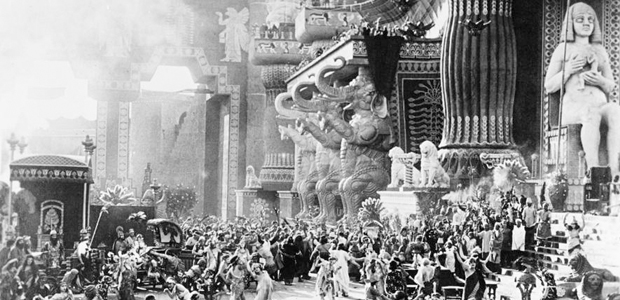
For starters, the scenes set in ancient Babylon are breathtaking.


Look at those set pieces! They are jaw-droppingly big.


A lot of live animals were used in the Babylon scenes to make them extra exotic.

Aside from being known for its sheer scale, this film is also known for its revolutionary editing style of intercutting multiple plotlines. As the film reaches its climax, the cuts get quicker and quicker. This style influenced European and Soviet filmmakers in particular.

Many of Griffith's assistant directors went on to illustrious Hollywood careers themselves, including Erich von Stroheim (Greed, Foolish Wives, Sunset Boulevard), Tod Browning (DraculaFreaks) and W.S. Van Dyke (The Thin Man, San Francisco).

I find it interesting that the controversy surrounding Griffith's earlier film and the commercial failure of this one did not halt his career. Despite the questionable content of his movies, the man is regarded as a genius and forefather of modern cinema. The question of whether you should you judge ones art separately from their personal life/beliefs is thrown around often in reference to controversial figures. The answer to the question when applied to D.W. Griffith is a resounding "yes." His artistry was impressive enough that people overlook his themes, but I have a hard time getting past them. This film really touched a nerve with me. The themes probably stick out to me the most because I'm a 21st-century viewer. I'm used to seeing big movies with special effects. While the set pieces and editing are impressive for their era, they don't make this a "good" movie to me.

Fun fact: false eyelashes were invented during the production of this film because Griffith wanted the Babylonian princess' eyelashes to be so long they brushed her cheeks when she blinked.

This film is available on Netflix.

Monday, January 21, 2013

4. Les Vampires (1915-16)

Les Vampires follows the adventures of Parisian newspaper reporter Philippe Guerande as he investigates a string of crimes committed by a gang called the Vampires.


He is aided along the way by his coworker Mazamette, who has been working undercover with the Vampires. Mazamette becomes Philippe's faithful sidekick and also provides comic relief throughout the movie.

Philippe and Mazamette spend much of their time entangled with a particular Vampires member, Irma Vep, as she carries out many of the gang's dastardly plans.

The plot is as follows (stolen from Wikipedia):

Episode 1 - The Severed Head

Philipe Guérande (Édouard Mathé), a reporter working for the newspaper "The Paris Chronicle" who is investigating a criminal organisation called the Vampires, receives a telegram at work stating that the decapitated body of the national security agent in charge of the Vampire investigations, Inspector Durtal, was found in the swamps near Saint-Clement-Sur-Cher, with the head missing. Being turned down by the local magistrate (Thelès), he spends the night in a nearby castle owned by Dr. Nox (Jean Aymé), an old friend of his father, along with Mrs. Simpson (Rita Herlor), an American multimillionaire who desires the property. After waking up in the night, Philipe finds a note in his pocket saying ‘Give up your search, otherwise bad luck awaits you! – The Vampires’ and a mysterious passage behind a painting in his room. Meanwhile, Mrs. Simpson’s money and jewels are stolen in her sleep by a masked thief, but Philipe is suspected of the crime. Philipe again visits the magistrate, who now believes his case, and they trick Dr. Nox and Mrs. Simpson into waiting in an anteroom. At the castle, Philipe and the magistrate find the head of Inspector Durtal hidden in the passage in Philipe’s room. Back in the anteroom, they find that Mrs. Simpson is dead and that Dr. Nox has vanished. Her pocket contains a note from the Grand Vampire saying that he has murdered the real Dr. Nox and is now assuming his identity.

Episode 2 - The Ring That Kills

Grand Vampire in disguise as Count de Noirmoutier, reads that ballerina Marfa Koutiloff (Stacia Napierkowska), who is engaged to Philipe, will perform a ballet called The Vampires. To prevent her from publicizing the Vampires' activities and to deter Philipe, he gives Marfa a poisoned ring before her performance, which kills her onstage. Amidst the panicking crowds Philipe recognizes the Grand Vampire and follows him to an abandoned fort and is captured by the gang. They agree to interrogate Philipe at midnight and execute him at dawn. Philipe finds that the Vampire guarding him is one of his co-workers, Oscar-Cloud Mazamette (Marcel Lévesque). They decide to work together and capture the Grand Inquisitor when he arrives at midnight. They bind and hood the Grand Inquisitor, and set him up for execution in place of Phillipe. At dawn the Vampires arrive for the execution, but the police raid the lair. The Vampires escape, but as they flee they mistakenly execute their own Grand Inquisitor, who turns out to be the Chief Justice of the Supreme Court.

Episode 3 - The Red Cypher

While faking illness to get off work, Philipe tries to decode a red booklet that he lifted from the Grand Inquisitor’s body, which contains the crimes of the Vampires. He discovers that his house is under surveillance by the Vampires, so he leaves in disguise. Following clues in the booklet he arrives at "The Howling Cat" night club. Performing there is Irma Vep (Musidora), whose name Philipe sees is an anagram for vampire. After her act, the Grand Vampire assigns Irma to retrieve the red booklet. As Philipe returns home Mazamette arrives, along with a poison pen he stole from the Grand Vampire. A few days later, Irma arrives at their house disguised as a new maid, but Philipe recognizes her. She tries to poison him, but fails. His mother (Delphine Renot) leaves to meet her brother after receiving word that he has been in a car accident, but it turns out to be a trap and she is captured by the Vampires. While Philipe is asleep, Irma lets another Vampire into his home but he shoots them. They escape, however, because his gun was loaded with blanks. In a shack in the slums, Philipe’s mother is held by Father Silence (Louis Leubas), a deaf-mute, and is forced to sign a ransom note, but she kills him with Mazamette’s poison pen and escapes.

Episode 4 - The Spectre

The Grand Vampire, under the alias of a real estate broker "Treps," meets Juan-José Moréno (Fernand Herrmann), a businessman, who asks for an apartment with a safe. The Grand Vampire puts Moréno into an apartment whose safe is rigged to be opened from the rear through the party wall of an apartment belonging to Irma Vep and the Grand Vampire. However, the case Moréno places inside contains the Vampires’ black attire. Later, in disguise as bank secretary "Juliette Bertaux," Irma learns that a man called Mr. Metadier has to bring300,000 to another branch. In the case that he is unable to make the delivery, Irma will. Soon afterward, Mr. Metadier is murdered by the Vampires and his body disposed of while on a train home from a film. When Irma is about to take the money for him a spectre of Mr. Metadier appears and takes it instead. The Grand Vampire pursues the spectre, who escapes down a manhole. Later that day, Mme. Metadier appears at the bank, saying she hasn’t seen her husband in days. They also find out that the money hasn’t been delivered. Philipe soon learns of this, and goes to the bank in disguise, recognizing Irma. He finds her address and a few hours later sneaks in, using Mazamette as a ploy. Irma and the Grand Vampire open the safe from their side, only to find Metadier’s body and the money. Philipe tries to capture them but is knocked down and they escape. Philipe calls the police just as Moréno enters and finds his safe opened from the other side. He walks through and is caught by Philipe. Moréno is revealed to be another criminal in disguise, and claims not to have killed Metadier, but to have found his body by the train tracks where the Vampires had dumped it. Moréno found Metadier's letter of authority on his corpse, took Metadier's body home, disguised himself as Metadier, put the body in his safe, assumed Metadier's identity, took the money, and put it too in his safe. The upshot is that the money is now in the Vampires' possession. The police arrive and arrest Moréno.

Episode 5 - Dead Man's Escape

The examining magistrate from Saint-Clement-Sur-Cher relocates to Paris and is assigned to the Vampire case and the Moréno affair. After being summoned to the magistrate, Moréno commits suicide using a concealed cyanide capsule. His body is left in his cell, but during the night he wakes up, very much alive. He kills the night-watchman and takes his clothes, escaping from the prison. He is noticed by Mazamette, who is suffering from insomnia. The following morning, Moréno is found to have escaped. While writing an account of the events, Philipe is pulled out of his window by the Vampires and whisked into a large costume box. He is driven away and the box is unloaded, but incompetently, and it slides down a large flight of stairs. The Vampires retreat and Philipe is let out by two bystanders. He visits the costume designer Pugenc whose name and box number (13) are on the costume box, just missing Moréno and his gang who have bought police uniforms for a scheme of their own. Philipe learns from Pugenc that the costume box was to go to Baron de Mortesalgues on Maillot Avenue, and realizes that "Mortesalgues" must be another alias of the Grand Vampire. Later, Moréno confronts Philipe in a café, but when Philipe calls for the nearby policemen, they turn out to be part of Moréno’s gang and he is again captured. Meanwhile, Mazamette breaks into Moréno’s hideout. Philipe is taken there to be hanged by the gang, unless he can give them means to revenge themselves against the Vampires. He tells them that Baron de Mortesalgues is the Grand Vampire, and they spare him, tying him up. Mazamette appears and frees him. That evening, the Grand Vampire, in disguise as Baron de Mortesalgues, holds a party for his "niece," who is Irma Vep in disguise. The party attracts many members of the Parisian aristocracy. "Mortesalgues" reveals that at midnight there will be a surprise; but the "surprise" is a sleeping-gas attack on the guests. The Vampires steal all of the guests' valuables while they are unconscious. The Vampires flee with the stolen items on the top of their car, but Moréno, forewarned by Philipe, robs the Vampires and sends Philipe a letter telling him that, for the moment, they are even. Mazamette visits Philipe; he is angry with their lack of progress and wants to quit. Philipe shows Mazamette a line from a book of Jean de la Fontaine’s Fables which states “in all things, one must take the end into account.” They renew their resolves.

Episode 6 - Hypnotic Eyes

Fifteen days have passed since the events at Maillot. Moréno is looking for clues to lead him to the Vampires, and reads in a paper that a Fontainebleau notary has been murdered by them; as he happens to possess a gaze with a terrible hypnotic power, he takes control of his new maid, Laura, to turn her into his slave. Meanwhile, Philipe and Mazamette happen to see a newsreel on the murder inquest, in which they spot Irma Vep and the Grand Vampire. They cycle to Fontainebleau to investigate. Enroute they spot an American tourist, Horatio Werner, riding fast into the forest, and follow him. He places a box under one of the boulders, and they take it. The Grand Vampire, who is staying in the Royal Hunt Hotel under the pseudonym of Count Kerlor, along with Irma in disguise as his son, Viscount Guy, reads in a paper that George Baldwin (Émile Keppens), an American millionaire, has been robbed of $200,000. Whoever can capture the criminal, Raphael Norton, who has fled to Europe with the actress Ethel Florid, will be awarded the unspent balance of the loot. "Kerlor" notices that Mr and Mrs. Werner, who are staying at the hotel, are distressed by this notice, and concludes that Mr. Werner is Raphael Norton. Philipe and Mazamette arrive at the hotel and find that the Vampires are based there. In a different hotel they force open the box and find Baldwin’s stolen money inside. Moréno comes to the Royal Hunt in disguise. While the Grand Vampire tells the hotel guests a story, Irma breaks into the Werners' suite, finding a map leading to the box in the forest. When she leaves, she is captured and chloroformed by Moréno, who takes the map. While his gang take Irma away, he dresses his hypnotized maid, Laura, as Irma and tells her to give the Vampires the map. Once one of the Vampires (Miss Édith) follows the map to get the treasure, Moréno’s gang ambushes her, only to find that Philipe has already taken it. Moreno demands that the Grand Vampire ransom Irma Vep. In the early morning, the police raid the hotel and find that Werner is actually Norton, so Philipe and Mazamette win the money. Moréno falls in love with Irma and decides not to return her to the Grand Vampire. Instead, he hypnotizes her and causes her to write a confession of her involvement in the murders of the Fontainbleau notary (in this episode), Metadier (episode 4), the ballerina Marfa Koutiloff (episode 2), and Dr. Nox (episode 1). The Grand Vampire comes to meet Moréno, but Moréno by hypnotic command compels Irma to kill him. The episode ends with the now-wealthy Mazamette informing a dozen adoring journalists that "although vice is seldom punished, virtue is always rewarded."

Episode 7 - Satanas

A mysterious man (Louis Leubas) arrives at Moréno’s home, and shows that he knows that the Grand Vampire’s body is inside a trunk. Moréno tries to get rid of him, but he is paralysed by a pin in the man’s glove. The man reveals himself to be the true Grand Vampire, Satanas, and that the first was a subordinate. While at a cabaret called the "Happy Shack", Moréno and Irma receive a note from Satanas saying they will see proof of his power at two o'clock. At two he fires a powerful cannon at the "Happy Shack", largely destroying it. Meanwhile, Philipe decides to visit Mazamette, but he is out "chasing the girls." He hides as Mazamette arrives home, drunk, with two women and a friend, who he later chases out angrily at gunpoint. The next morning, Irma and Moréno go to Satanas’ home to surrender, and Satanas offers them the chance to work with him, informing them that American millionaire George Baldwin is stopping at the Park Hotel. Satanas wants Baldwin's signature. One of Moréno’s accomplices, Lily Flower (Suzanne Delvé), goes to the Park Hotel and poses as an interviewer from "Modern Woman" magazine and through trickery gets Baldwin to sign a blank piece of paper. Afterwards, Irma enters and dupes Baldwin into recording his voice saying "Parisian women are the most charming I've ever seen, all right!" Lily Flower brings Baldwin's signature to Moréno’s home, and Moréno writes out an order (over Baldwin's signature) to pay Lily Flower $100,000. Moréno’s gang seize the hotel telephone operator of Baldwin's hotel; Irma takes her place by using a forged note. When the bank cashier calls Baldwin to confirm that he has given a very large draft to an attractive Parisian woman, Irma intercepts the call, and plays the recording she made of Baldwin's voice, and the cashier is persuaded. While Lily Flower is taking the money, Mazamette comes in, recognising her as his old squeeze from the "Happy Shack", and follows her, seeing her hand the money to a man in a taxi—Moréno! Moréno gives Satanas the money, but he is given it back as a present. Philipe and Mazamette capture Lily Flower at her home and make her call Moréno and tell him to come, but when he and Irma arrive they fall into a trap and are caught by the police.

Episode 8 - The Thunder Master

Irma, sentenced to life imprisonment, has been sent to St. Lazarus’ prison. A transfer order is sent to the prison to send Irma to a penal colony in Algeria. On the day of her departure, Irma finds out that Moréno has been executed. Satanas follows Irma’s transportation route, stopping at a seaside hotel in disguise as a Priest. At the port, he gives some religious comfort to the prisoners, but Irma’s copy contains a secret message saying “the ship will blow up” and giving her directions on how to safeguard herself. Satanas destroys the ship with his cannon. Meanwhile, Philipe finds through the red codebook that the explosive shell that landed on the “Happy Shack” came from Montmartre, and Mazamette goes to investigate. His son, Eustache Mazamette (René Poyen), is sent home from school due to bad behaviour, so they go to "investigate" together. They find some men loading boxes into a house, and notice one of the top hat cases contains a shell. Later, reading that no survivors have been found from the exploding ship, Satanas visits Philipe to avenge Irma’s death. Satanas paralyses Phillipe with the poisoned pin in his glove and leaves a bomb in a top hat to kill him off. Mazamette arrives and throws the top hat out the window just in time. At Satanas’ home, Eustache is used as a ploy to hide Mazamette in a box, but Satanas sees this through a spy-hole. Satanas threatens Eustache, but Eustache shoots at Satanas, and the police raid the building and arrest him. After the action, they find that Mazamette’s nose has been broken by Eustache’s shot. Meanwhile, Irma is shown to have survived the blast on the ship, and is trying to get back to Paris from under a train. She is helped by the station staff and police, pretending that she is in “one of those eternal love stories beloved by popular imagination.” She makes her way to the Vampire hangout, the “Howling Cat” nightclub, where she performs, and is rapturously greeted by the Vampires. Upon hearing of the arrest of Satanas, one of the Vampires, Venomous (Frederik Moris), appoints himself the new chief. By Satanas’ orders, they mail him an envelope containing a poisoned note, which he eats to commit suicide.

Episode 9 - The Poinsoner

Irma is now a devoted collaborator of Venomous, who is set on getting rid of Philipe and Mazamette. He learns that Philipe is engaged to Jane Bremontier (Louise Lagrange), and the following day Irma and Lily Flower rent an apartment above hers. Irma’s maid, a Vampire also, hears that Philipe and Jane’s engagement party will be catered for by the famous Béchamel House. Venomous cancels their catering order, and on the day of the party the Vampires appear instead. Jane’s mother (Jeanne Marie-Laurent) gives the concierges one bottle of the Vampires' champagne as a present, and just as dinner is served the male concierge, Leon Charlet, drinks it, is poisoned and dies. His wife stops the party guests from drinking their champagne just in time, and the Vampires make a hasty escape. A few days later, Mazamette and Philipe’s mother pick up Jane and her mother in the night in order to take them to a safe retreat near Fontainebleau. Irma, who tries to fill the getaway car with soporific gas, is spotted by Mazamette, but Irma gasses him, and he is taken away asleep while Irma hides in a box on the car. Mazamette is dumped on the street and taken to the police station, believed to be drunk. When he wakens, he calls Philipe to warn him, but Irma slips out of the box and gets away in the car before Philipe can catch her. Irma jumps off the car near the Pyramid Hotel, and calls Venomous to meet her there, but Philipe has also arranged to meet Mazamette there. Philipe spots Irma at the Pyramid Hotel, captures her and ties her up. Philipe and Mazamette leave Irma in Mazamette's car and attempt to ambush Venomous, but Irma honks the car horn to warn him. Venomous saves Irma and drives off in Mazamette’s car, so Philipe and Mazamette chase him in his. Venomous leaps off; Philipe chases Venomous on foot, following him onto the top of a moving train, but Venomous gets away. Mazamette, enraged at the police for not letting him help Philipe on the train, hits one of the officers, who arrest him. At the police station, Philipe and Mazamette carry on so dramatically that the police decide not to book Mazamette, who is after all a famous philanthropist. But the Vampires are still on the loose.

Episode 10 - The Terrible Wedding

A few months after their engagement party, and little news of the Vampires, Philipe and Jane are now married. Augustine Charlet (Germaine Rouer), widow of the poisoned concierge, is invited by the Guérandes to be their chamber maid, which she accepts. The following day, she receives a letter from the Vampires detailing that she should consult Madame d’Alba at 13 Avenue Junot. When she does, Mazamette, who has taken an attraction to her, follows her. Madame d’Alba, a Vampire, hypnotises Augustine and instructs her to unlock the door of Philipe’s apartment at 2 am to let the Vampires in. Mazamette catches her as she leaves, and he promises not to tell Philipe of the incident. Unable to sleep that night, he sees her let the Vampires in, and they tie her up and feed poisonous gas into the Guérandes’ room. He shoots at them and they flee, and Augustine explains her actions. As they go to the police, Venomous tries to break in through a bedroom window, but Jane shoots at him. When she looks out the window she is lassoed down and carried away. At daybreak, the police raid Avenue Junot. Irma and Venomous escape through the roof and drive away, capturing Augustine. Mazamette shoots at the car, causing an oil leak. Philipe follows the trail to the Vampires’ lair and lays traps at nightfall while the gang celebrate the wedding of Irma and Venomous. The police do a large scale police raid at daybreak, while the Vampires are still celebrating. As Irma hides, all of the Vampires are either killed or captured by the police. She confronts their captives, but is shot by Jane. Paris now being safe from the Vampires, Mazamette proposes to Augustine and she accepts.
___________________________________________________________________


The movie was inspired by real events: gangs called Apaches preyed on the French middle class in the years leading up to World War I. One gang in particular, the Bonnot Gang, is cited as being the basis for the Vampires.

As I mentioned earlier, Les Vampires is credited with establishing the crime thriller genre and was influential to directors such as Fritz Lang (M, The Big Heat) and Alfred Hitchcock. You can find certain themes of Les Vampires in later movies by Hitchcock: ordinary people caught in extraordinary circumstances (Philippe and his family members), characters falling from high places (there are a lot of scenes in Les Vampires that involve balconies or rooftop windows), food + death (one character is poisoned and killed at an engagement dinner), and violence in public places (innocents are terrorized at a party, a hotel, etc.).

Irma Vep is the first femme fatale to appear in a movie on the 1001 list, even though that archetypal character was already in use by other filmmakers at the time. (Ultimate real-life femme fatale Mata Hari would go down in history for meeting her demise just one year after the final episode of Les Vampires was released). Even before this film was made, there existed a connection between vampire and femme fatale: femme fatales were described as "sexual vampires" who seduced their male counterparts and sucked all the willpower out of them, thus rendering them helpless to the dark females' evil plans. This is why vixen-y female characters are called "vamps." Proof of Irma Vep's vamp-ness: she switches sides with at least one foe during the movie and becomes his lover; she is a cabaret-style performer and a "deadly woman" (the literal translation of femme fatale).

Fun fact - In 1996, French director Olivier Assayas made a film called Irma Vep that revolves around a fictional remaking of Les Vampires starring Maggie Cheung. If you search for "Irma Vep" on Google, the results will pop up with a bunch of pictures showing Maggie Cheung in a black bodysuit.

Although Les Vampires was criticized at its release for "not having the artistry of a D.W. Griffith film," there were a lot of striking visuals that stuck with me.

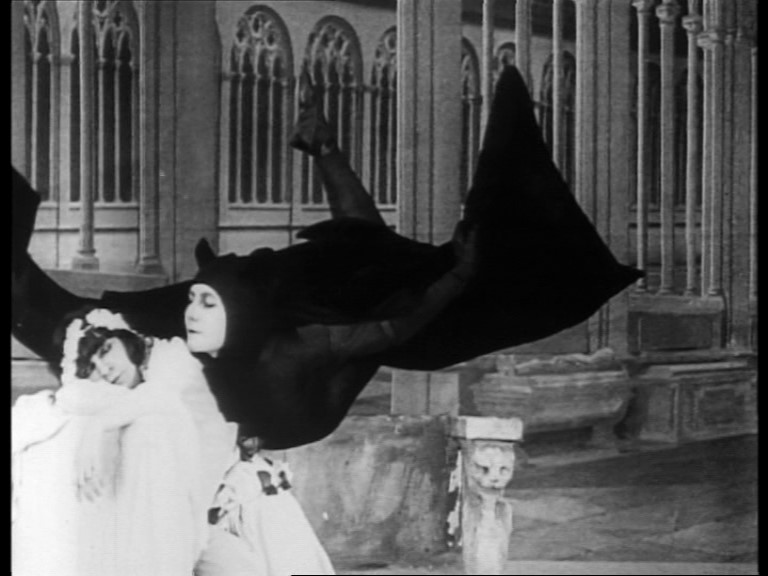
Episode 2 - A ballerina costumed as a vampire bat descends onto the stage and begins her eerie dance, only to then die suddenly during the performance.


Episode 8 - Mazamette and his son go to the Grand Vampire's house to investigate. The Grand Vampire sends his manservant out to greet them, but watches through a mask he has installed in the wall that lets him spy on the entryway.


Cross-section of the two rooms as the Grand Vampire watches his guests enter.


The mask as it looks from the front. Mazamette and his son have no idea they are being watched.

There are also a couple of scenes that use stop-motion.


Philippe comes across this sign, and as the camera shows it from his point of view, the letters move around to reveal their hidden meaning (Irma Vep's name is an anagram for Vampire). I did not know stop motion had been in use this early! Pretty cool.

Mazamette's son randomly shows up in episode 8 after never having been mentioned throughout the previous episodes. Like his dad, he provides a lot of comic relief, but then he disappears again and is never mentioned in episodes 9 or 10. I wish they had used that child actor more because he was pretty funny and brought some lightheartedness to the film. His name in the film is "Eustache" while the elder Mazamette's first name is "Oscar-Cloud" but he's usually just called Mazamette.


The guy who plays Mazamette (Marcel Levesque) is perfect. Just look at him! He oozes comedy. There's even a scene in the last episode where some other characters make fun of his big nose. Mazamette has now been added to my list of great supporting characters in movies and literature.

Musidoria (Irma Vep) would go on to be a star of French cinema, and director Louis Feuillade kept cranking out his own films. He directed over 630 films (!!!!!) between 1906 and 1924. Maybe that's why he looks so pleased with himself here.


"Yep, I'm pretty awesome. I mean, just look at my mustache! C'est magnifique!"