Les Vampires follows the adventures of Parisian newspaper reporter Philippe Guerande as he investigates a string of crimes committed by a gang called the Vampires.
He is aided along the way by his coworker Mazamette, who has been working undercover with the Vampires. Mazamette becomes Philippe's faithful sidekick and also provides comic relief throughout the movie.
Philippe and Mazamette spend much of their time entangled with a particular Vampires member, Irma Vep, as she carries out many of the gang's dastardly plans.
The plot is as follows (stolen from Wikipedia):
Episode 1 - The Severed Head
Philipe Guérande (Édouard Mathé), a reporter working for the newspaper "The Paris Chronicle" who is investigating a criminal organisation called the Vampires, receives a telegram at work stating that the decapitated body of the national security agent in charge of the Vampire investigations, Inspector Durtal, was found in the swamps near Saint-Clement-Sur-Cher, with the head missing. Being turned down by the local magistrate (Thelès), he spends the night in a nearby castle owned by Dr. Nox (Jean Aymé), an old friend of his father, along with Mrs. Simpson (Rita Herlor), an American multimillionaire who desires the property. After waking up in the night, Philipe finds a note in his pocket saying ‘Give up your search, otherwise bad luck awaits you! – The Vampires’ and a mysterious passage behind a painting in his room. Meanwhile, Mrs. Simpson’s money and jewels are stolen in her sleep by a masked thief, but Philipe is suspected of the crime. Philipe again visits the magistrate, who now believes his case, and they trick Dr. Nox and Mrs. Simpson into waiting in an anteroom. At the castle, Philipe and the magistrate find the head of Inspector Durtal hidden in the passage in Philipe’s room. Back in the anteroom, they find that Mrs. Simpson is dead and that Dr. Nox has vanished. Her pocket contains a note from the Grand Vampire saying that he has murdered the real Dr. Nox and is now assuming his identity.
Episode 2 - The Ring That Kills
Grand Vampire in disguise as Count de Noirmoutier, reads that ballerina Marfa Koutiloff (Stacia Napierkowska), who is engaged to Philipe, will perform a ballet called The Vampires. To prevent her from publicizing the Vampires' activities and to deter Philipe, he gives Marfa a poisoned ring before her performance, which kills her onstage. Amidst the panicking crowds Philipe recognizes the Grand Vampire and follows him to an abandoned fort and is captured by the gang. They agree to interrogate Philipe at midnight and execute him at dawn. Philipe finds that the Vampire guarding him is one of his co-workers, Oscar-Cloud Mazamette (Marcel Lévesque). They decide to work together and capture the Grand Inquisitor when he arrives at midnight. They bind and hood the Grand Inquisitor, and set him up for execution in place of Phillipe. At dawn the Vampires arrive for the execution, but the police raid the lair. The Vampires escape, but as they flee they mistakenly execute their own Grand Inquisitor, who turns out to be the Chief Justice of the Supreme Court.
Episode 3 - The Red Cypher
While faking illness to get off work, Philipe tries to decode a red booklet that he lifted from the Grand Inquisitor’s body, which contains the crimes of the Vampires. He discovers that his house is under surveillance by the Vampires, so he leaves in disguise. Following clues in the booklet he arrives at "The Howling Cat" night club. Performing there is Irma Vep (Musidora), whose name Philipe sees is an anagram for vampire. After her act, the Grand Vampire assigns Irma to retrieve the red booklet. As Philipe returns home Mazamette arrives, along with a poison pen he stole from the Grand Vampire. A few days later, Irma arrives at their house disguised as a new maid, but Philipe recognizes her. She tries to poison him, but fails. His mother (Delphine Renot) leaves to meet her brother after receiving word that he has been in a car accident, but it turns out to be a trap and she is captured by the Vampires. While Philipe is asleep, Irma lets another Vampire into his home but he shoots them. They escape, however, because his gun was loaded with blanks. In a shack in the slums, Philipe’s mother is held by Father Silence (Louis Leubas), a deaf-mute, and is forced to sign a ransom note, but she kills him with Mazamette’s poison pen and escapes.
Episode 4 - The Spectre
The Grand Vampire, under the alias of a real estate broker "Treps," meets Juan-José Moréno (Fernand Herrmann), a businessman, who asks for an apartment with a safe. The Grand Vampire puts Moréno into an apartment whose safe is rigged to be opened from the rear through the party wall of an apartment belonging to Irma Vep and the Grand Vampire. However, the case Moréno places inside contains the Vampires’ black attire. Later, in disguise as bank secretary "Juliette Bertaux," Irma learns that a man called Mr. Metadier has to bring₣300,000 to another branch. In the case that he is unable to make the delivery, Irma will. Soon afterward, Mr. Metadier is murdered by the Vampires and his body disposed of while on a train home from a film. When Irma is about to take the money for him a spectre of Mr. Metadier appears and takes it instead. The Grand Vampire pursues the spectre, who escapes down a manhole. Later that day, Mme. Metadier appears at the bank, saying she hasn’t seen her husband in days. They also find out that the money hasn’t been delivered. Philipe soon learns of this, and goes to the bank in disguise, recognizing Irma. He finds her address and a few hours later sneaks in, using Mazamette as a ploy. Irma and the Grand Vampire open the safe from their side, only to find Metadier’s body and the money. Philipe tries to capture them but is knocked down and they escape. Philipe calls the police just as Moréno enters and finds his safe opened from the other side. He walks through and is caught by Philipe. Moréno is revealed to be another criminal in disguise, and claims not to have killed Metadier, but to have found his body by the train tracks where the Vampires had dumped it. Moréno found Metadier's letter of authority on his corpse, took Metadier's body home, disguised himself as Metadier, put the body in his safe, assumed Metadier's identity, took the money, and put it too in his safe. The upshot is that the money is now in the Vampires' possession. The police arrive and arrest Moréno.
Episode 5 - Dead Man's Escape
The examining magistrate from Saint-Clement-Sur-Cher relocates to Paris and is assigned to the Vampire case and the Moréno affair. After being summoned to the magistrate, Moréno commits suicide using a concealed cyanide capsule. His body is left in his cell, but during the night he wakes up, very much alive. He kills the night-watchman and takes his clothes, escaping from the prison. He is noticed by Mazamette, who is suffering from insomnia. The following morning, Moréno is found to have escaped. While writing an account of the events, Philipe is pulled out of his window by the Vampires and whisked into a large costume box. He is driven away and the box is unloaded, but incompetently, and it slides down a large flight of stairs. The Vampires retreat and Philipe is let out by two bystanders. He visits the costume designer Pugenc whose name and box number (13) are on the costume box, just missing Moréno and his gang who have bought police uniforms for a scheme of their own. Philipe learns from Pugenc that the costume box was to go to Baron de Mortesalgues on Maillot Avenue, and realizes that "Mortesalgues" must be another alias of the Grand Vampire. Later, Moréno confronts Philipe in a café, but when Philipe calls for the nearby policemen, they turn out to be part of Moréno’s gang and he is again captured. Meanwhile, Mazamette breaks into Moréno’s hideout. Philipe is taken there to be hanged by the gang, unless he can give them means to revenge themselves against the Vampires. He tells them that Baron de Mortesalgues is the Grand Vampire, and they spare him, tying him up. Mazamette appears and frees him. That evening, the Grand Vampire, in disguise as Baron de Mortesalgues, holds a party for his "niece," who is Irma Vep in disguise. The party attracts many members of the Parisian aristocracy. "Mortesalgues" reveals that at midnight there will be a surprise; but the "surprise" is a sleeping-gas attack on the guests. The Vampires steal all of the guests' valuables while they are unconscious. The Vampires flee with the stolen items on the top of their car, but Moréno, forewarned by Philipe, robs the Vampires and sends Philipe a letter telling him that, for the moment, they are even. Mazamette visits Philipe; he is angry with their lack of progress and wants to quit. Philipe shows Mazamette a line from a book of Jean de la Fontaine’s Fables which states “in all things, one must take the end into account.” They renew their resolves.
Episode 6 - Hypnotic Eyes
Fifteen days have passed since the events at Maillot. Moréno is looking for clues to lead him to the Vampires, and reads in a paper that a Fontainebleau notary has been murdered by them; as he happens to possess a gaze with a terrible hypnotic power, he takes control of his new maid, Laura, to turn her into his slave. Meanwhile, Philipe and Mazamette happen to see a newsreel on the murder inquest, in which they spot Irma Vep and the Grand Vampire. They cycle to Fontainebleau to investigate. Enroute they spot an American tourist, Horatio Werner, riding fast into the forest, and follow him. He places a box under one of the boulders, and they take it. The Grand Vampire, who is staying in the Royal Hunt Hotel under the pseudonym of Count Kerlor, along with Irma in disguise as his son, Viscount Guy, reads in a paper that George Baldwin (Émile Keppens), an American millionaire, has been robbed of $200,000. Whoever can capture the criminal, Raphael Norton, who has fled to Europe with the actress Ethel Florid, will be awarded the unspent balance of the loot. "Kerlor" notices that Mr and Mrs. Werner, who are staying at the hotel, are distressed by this notice, and concludes that Mr. Werner is Raphael Norton. Philipe and Mazamette arrive at the hotel and find that the Vampires are based there. In a different hotel they force open the box and find Baldwin’s stolen money inside. Moréno comes to the Royal Hunt in disguise. While the Grand Vampire tells the hotel guests a story, Irma breaks into the Werners' suite, finding a map leading to the box in the forest. When she leaves, she is captured and chloroformed by Moréno, who takes the map. While his gang take Irma away, he dresses his hypnotized maid, Laura, as Irma and tells her to give the Vampires the map. Once one of the Vampires (Miss Édith) follows the map to get the treasure, Moréno’s gang ambushes her, only to find that Philipe has already taken it. Moreno demands that the Grand Vampire ransom Irma Vep. In the early morning, the police raid the hotel and find that Werner is actually Norton, so Philipe and Mazamette win the money. Moréno falls in love with Irma and decides not to return her to the Grand Vampire. Instead, he hypnotizes her and causes her to write a confession of her involvement in the murders of the Fontainbleau notary (in this episode), Metadier (episode 4), the ballerina Marfa Koutiloff (episode 2), and Dr. Nox (episode 1). The Grand Vampire comes to meet Moréno, but Moréno by hypnotic command compels Irma to kill him. The episode ends with the now-wealthy Mazamette informing a dozen adoring journalists that "although vice is seldom punished, virtue is always rewarded."
Episode 7 - Satanas
A mysterious man (Louis Leubas) arrives at Moréno’s home, and shows that he knows that the Grand Vampire’s body is inside a trunk. Moréno tries to get rid of him, but he is paralysed by a pin in the man’s glove. The man reveals himself to be the true Grand Vampire, Satanas, and that the first was a subordinate. While at a cabaret called the "Happy Shack", Moréno and Irma receive a note from Satanas saying they will see proof of his power at two o'clock. At two he fires a powerful cannon at the "Happy Shack", largely destroying it. Meanwhile, Philipe decides to visit Mazamette, but he is out "chasing the girls." He hides as Mazamette arrives home, drunk, with two women and a friend, who he later chases out angrily at gunpoint. The next morning, Irma and Moréno go to Satanas’ home to surrender, and Satanas offers them the chance to work with him, informing them that American millionaire George Baldwin is stopping at the Park Hotel. Satanas wants Baldwin's signature. One of Moréno’s accomplices, Lily Flower (Suzanne Delvé), goes to the Park Hotel and poses as an interviewer from "Modern Woman" magazine and through trickery gets Baldwin to sign a blank piece of paper. Afterwards, Irma enters and dupes Baldwin into recording his voice saying "Parisian women are the most charming I've ever seen, all right!" Lily Flower brings Baldwin's signature to Moréno’s home, and Moréno writes out an order (over Baldwin's signature) to pay Lily Flower $100,000. Moréno’s gang seize the hotel telephone operator of Baldwin's hotel; Irma takes her place by using a forged note. When the bank cashier calls Baldwin to confirm that he has given a very large draft to an attractive Parisian woman, Irma intercepts the call, and plays the recording she made of Baldwin's voice, and the cashier is persuaded. While Lily Flower is taking the money, Mazamette comes in, recognising her as his old squeeze from the "Happy Shack", and follows her, seeing her hand the money to a man in a taxi—Moréno! Moréno gives Satanas the money, but he is given it back as a present. Philipe and Mazamette capture Lily Flower at her home and make her call Moréno and tell him to come, but when he and Irma arrive they fall into a trap and are caught by the police.
Episode 8 - The Thunder Master
Irma, sentenced to life imprisonment, has been sent to St. Lazarus’ prison. A transfer order is sent to the prison to send Irma to a penal colony in Algeria. On the day of her departure, Irma finds out that Moréno has been executed. Satanas follows Irma’s transportation route, stopping at a seaside hotel in disguise as a Priest. At the port, he gives some religious comfort to the prisoners, but Irma’s copy contains a secret message saying “the ship will blow up” and giving her directions on how to safeguard herself. Satanas destroys the ship with his cannon. Meanwhile, Philipe finds through the red codebook that the explosive shell that landed on the “Happy Shack” came from Montmartre, and Mazamette goes to investigate. His son, Eustache Mazamette (René Poyen), is sent home from school due to bad behaviour, so they go to "investigate" together. They find some men loading boxes into a house, and notice one of the top hat cases contains a shell. Later, reading that no survivors have been found from the exploding ship, Satanas visits Philipe to avenge Irma’s death. Satanas paralyses Phillipe with the poisoned pin in his glove and leaves a bomb in a top hat to kill him off. Mazamette arrives and throws the top hat out the window just in time. At Satanas’ home, Eustache is used as a ploy to hide Mazamette in a box, but Satanas sees this through a spy-hole. Satanas threatens Eustache, but Eustache shoots at Satanas, and the police raid the building and arrest him. After the action, they find that Mazamette’s nose has been broken by Eustache’s shot. Meanwhile, Irma is shown to have survived the blast on the ship, and is trying to get back to Paris from under a train. She is helped by the station staff and police, pretending that she is in “one of those eternal love stories beloved by popular imagination.” She makes her way to the Vampire hangout, the “Howling Cat” nightclub, where she performs, and is rapturously greeted by the Vampires. Upon hearing of the arrest of Satanas, one of the Vampires, Venomous (Frederik Moris), appoints himself the new chief. By Satanas’ orders, they mail him an envelope containing a poisoned note, which he eats to commit suicide.
Episode 9 - The Poinsoner
Irma is now a devoted collaborator of Venomous, who is set on getting rid of Philipe and Mazamette. He learns that Philipe is engaged to Jane Bremontier (Louise Lagrange), and the following day Irma and Lily Flower rent an apartment above hers. Irma’s maid, a Vampire also, hears that Philipe and Jane’s engagement party will be catered for by the famous Béchamel House. Venomous cancels their catering order, and on the day of the party the Vampires appear instead. Jane’s mother (Jeanne Marie-Laurent) gives the concierges one bottle of the Vampires' champagne as a present, and just as dinner is served the male concierge, Leon Charlet, drinks it, is poisoned and dies. His wife stops the party guests from drinking their champagne just in time, and the Vampires make a hasty escape. A few days later, Mazamette and Philipe’s mother pick up Jane and her mother in the night in order to take them to a safe retreat near Fontainebleau. Irma, who tries to fill the getaway car with soporific gas, is spotted by Mazamette, but Irma gasses him, and he is taken away asleep while Irma hides in a box on the car. Mazamette is dumped on the street and taken to the police station, believed to be drunk. When he wakens, he calls Philipe to warn him, but Irma slips out of the box and gets away in the car before Philipe can catch her. Irma jumps off the car near the Pyramid Hotel, and calls Venomous to meet her there, but Philipe has also arranged to meet Mazamette there. Philipe spots Irma at the Pyramid Hotel, captures her and ties her up. Philipe and Mazamette leave Irma in Mazamette's car and attempt to ambush Venomous, but Irma honks the car horn to warn him. Venomous saves Irma and drives off in Mazamette’s car, so Philipe and Mazamette chase him in his. Venomous leaps off; Philipe chases Venomous on foot, following him onto the top of a moving train, but Venomous gets away. Mazamette, enraged at the police for not letting him help Philipe on the train, hits one of the officers, who arrest him. At the police station, Philipe and Mazamette carry on so dramatically that the police decide not to book Mazamette, who is after all a famous philanthropist. But the Vampires are still on the loose.
Episode 10 - The Terrible Wedding
A few months after their engagement party, and little news of the Vampires, Philipe and Jane are now married. Augustine Charlet (Germaine Rouer), widow of the poisoned concierge, is invited by the Guérandes to be their chamber maid, which she accepts. The following day, she receives a letter from the Vampires detailing that she should consult Madame d’Alba at 13 Avenue Junot. When she does, Mazamette, who has taken an attraction to her, follows her. Madame d’Alba, a Vampire, hypnotises Augustine and instructs her to unlock the door of Philipe’s apartment at 2 am to let the Vampires in. Mazamette catches her as she leaves, and he promises not to tell Philipe of the incident. Unable to sleep that night, he sees her let the Vampires in, and they tie her up and feed poisonous gas into the Guérandes’ room. He shoots at them and they flee, and Augustine explains her actions. As they go to the police, Venomous tries to break in through a bedroom window, but Jane shoots at him. When she looks out the window she is lassoed down and carried away. At daybreak, the police raid Avenue Junot. Irma and Venomous escape through the roof and drive away, capturing Augustine. Mazamette shoots at the car, causing an oil leak. Philipe follows the trail to the Vampires’ lair and lays traps at nightfall while the gang celebrate the wedding of Irma and Venomous. The police do a large scale police raid at daybreak, while the Vampires are still celebrating. As Irma hides, all of the Vampires are either killed or captured by the police. She confronts their captives, but is shot by Jane. Paris now being safe from the Vampires, Mazamette proposes to Augustine and she accepts.
___________________________________________________________________
The movie was inspired by real events: gangs called Apaches preyed on the French middle class in the years leading up to World War I. One gang in particular, the Bonnot Gang, is cited as being the basis for the Vampires.
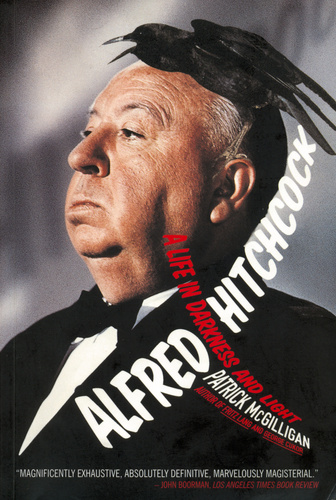
As I mentioned earlier, Les Vampires is credited with establishing the crime thriller genre and was influential to directors such as Fritz Lang (M, The Big Heat) and Alfred Hitchcock. You can find certain themes of Les Vampires in later movies by Hitchcock: ordinary people caught in extraordinary circumstances (Philippe and his family members), characters falling from high places (there are a lot of scenes in Les Vampires that involve balconies or rooftop windows), food + death (one character is poisoned and killed at an engagement dinner), and violence in public places (innocents are terrorized at a party, a hotel, etc.).
Irma Vep is the first femme fatale to appear in a movie on the 1001 list, even though that archetypal character was already in use by other filmmakers at the time. (Ultimate real-life femme fatale Mata Hari would go down in history for meeting her demise just one year after the final episode of Les Vampires was released). Even before this film was made, there existed a connection between vampire and femme fatale: femme fatales were described as "sexual vampires" who seduced their male counterparts and sucked all the willpower out of them, thus rendering them helpless to the dark females' evil plans. This is why vixen-y female characters are called "vamps." Proof of Irma Vep's vamp-ness: she switches sides with at least one foe during the movie and becomes his lover; she is a cabaret-style performer and a "deadly woman" (the literal translation of femme fatale).
Fun fact - In 1996, French director Olivier Assayas made a film called Irma Vep that revolves around a fictional remaking of Les Vampires starring Maggie Cheung. If you search for "Irma Vep" on Google, the results will pop up with a bunch of pictures showing Maggie Cheung in a black bodysuit.
Although Les Vampires was criticized at its release for "not having the artistry of a D.W. Griffith film," there were a lot of striking visuals that stuck with me.
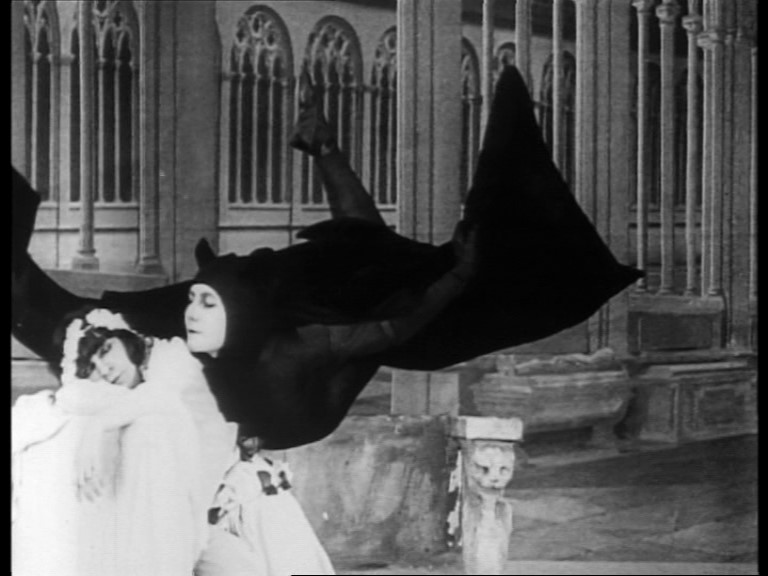
Episode 2 - A ballerina costumed as a vampire bat descends onto the stage and begins her eerie dance, only to then die suddenly during the performance.
Episode 8 - Mazamette and his son go to the Grand Vampire's house to investigate. The Grand Vampire sends his manservant out to greet them, but watches through a mask he has installed in the wall that lets him spy on the entryway.
Cross-section of the two rooms as the Grand Vampire watches his guests enter.
The mask as it looks from the front. Mazamette and his son have no idea they are being watched.
There are also a couple of scenes that use stop-motion.
Philippe comes across this sign, and as the camera shows it from his point of view, the letters move around to reveal their hidden meaning (Irma Vep's name is an anagram for Vampire). I did not know stop motion had been in use this early! Pretty cool.
Mazamette's son randomly shows up in episode 8 after never having been mentioned throughout the previous episodes. Like his dad, he provides a lot of comic relief, but then he disappears again and is never mentioned in episodes 9 or 10. I wish they had used that child actor more because he was pretty funny and brought some lightheartedness to the film. His name in the film is "Eustache" while the elder Mazamette's first name is "Oscar-Cloud" but he's usually just called Mazamette.
The guy who plays Mazamette (Marcel Levesque) is perfect. Just look at him! He oozes comedy. There's even a scene in the last episode where some other characters make fun of his big nose. Mazamette has now been added to my list of great supporting characters in movies and literature.
Musidoria (Irma Vep) would go on to be a star of French cinema, and director Louis Feuillade kept cranking out his own films. He directed over 630 films (!!!!!) between 1906 and 1924. Maybe that's why he looks so pleased with himself here.
"Yep, I'm pretty awesome. I mean, just look at my mustache! C'est magnifique!"








.jpg)



.jpg)
.jpg)
%20car.jpg)